You have seen two kinds of offer. One person says they can set up a website by tomorrow using a ready-made template. Another says a custom website will take a few weeks and cost more. Both sound confident, and you can't tell what the real difference is.
This post explains it plainly — including the cases where a template is the sensible choice.
What is the difference between a template and a custom website?
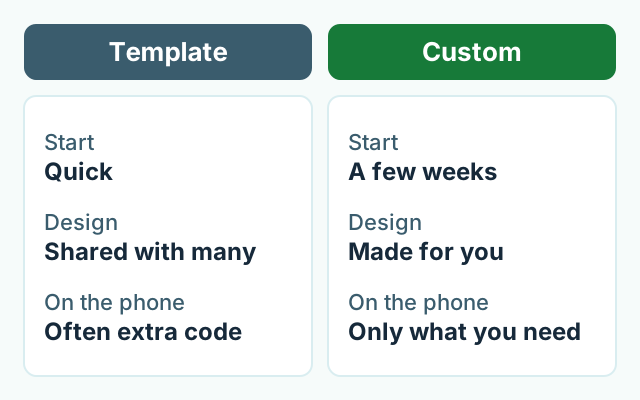
A template website starts from a ready-made design that many other businesses also use; a custom website is designed and built around your business only. A template is faster and cheaper to start, and it is fine for a simple online presence. A custom site is usually lighter on mobile data, fits exactly what your customers need to do, and is easier to own outright. The right choice depends on what the website has to do for you, not on which one sounds more professional.
Think of it like clothes. A template is ready-made from the market: quick, affordable, and it fits most people reasonably well. Custom is tailored: it takes longer and costs more, but it fits you.
Why does speed on mobile data matter so much?
Most of your customers will open your website on a phone, often on mobile data, sometimes with a weak signal in a market or during load-shedding when Wi-Fi is down. If the page takes too long, they go back to Google and tap the next result.
Many popular templates are built to impress in a demo. To suit thousands of different buyers, they ship with sliders, animations, extra fonts and features you will never use. All of that still loads on your customer's phone. A custom site only carries what your business actually needs, so it is usually lighter.
To be fair, this is not automatic. A carefully chosen, simple template can be fast, and a badly built custom site can be slow. Test any site — yours or a sample — on a phone using mobile data, not office Wi-Fi. We wrote more about this in why a website is slow on mobile.
Who owns a template website?
This is the question people forget to ask, and it matters more than design.
With a template, there are usually two things to check:
- Where it lives. Some template sites run on a website-builder platform. You are renting space there. If you stop paying, or want to move, you often can't take the site with you — only your text and photos.
- Whose account it is on. A common problem in Pakistan: the person who set it up registered the domain and hosting in their name. When they become busy or change numbers, you can't renew, edit or move your own website.
A custom site isn't automatically safer either — the same account problem can happen with anyone. What protects you is a written promise that the domain, hosting, code and every account are in your name at handover. That is how we work: full handover, so any developer can take over later.
When is a template perfectly fine?
Honestly, often. A template is a sensible choice when:
- You need something online this week, for example before an exhibition or a new branch opening.
- The website is a digital visiting card — who you are, what you do, your phone number and location — and nothing more.
- Your budget is tight right now and you would rather spend on stock or staff. Starting simple and upgrading later is a reasonable plan.
- You are testing an idea and don't yet know if the business will continue.
Say you run a tuition centre in Gujranwala and parents only need your timings, subjects and WhatsApp number. A clean, light template — or even a well-kept Google Business Profile — can do that job well for now.
When is a custom website worth it?
The balance tips towards custom when the website has to do something specific:
- Customers book, order or pay. Say you run a bakery in Lahore that takes cake orders with a pickup time and an advance on JazzCash. Bending a template to that exact flow often costs more effort than building it right.
- You need to stand out from competitors. If three salons in your area use the same popular theme, customers notice.
- You need Urdu and English that both look right, not one language squeezed into a design made for the other.
- You plan to grow it — more products, a customer login, an admin panel your staff can use.
- You've already been burned by a slow site you couldn't change.
At 77-Technologies we only build custom designs; we don't buy themes. A custom business website with us starts from PKR 50,000 and takes 2–3 weeks, and you approve the design before any building starts. You can see what's included in our fixed-price packages, and examples of finished projects in our recent work.
How do you decide? A short checklist
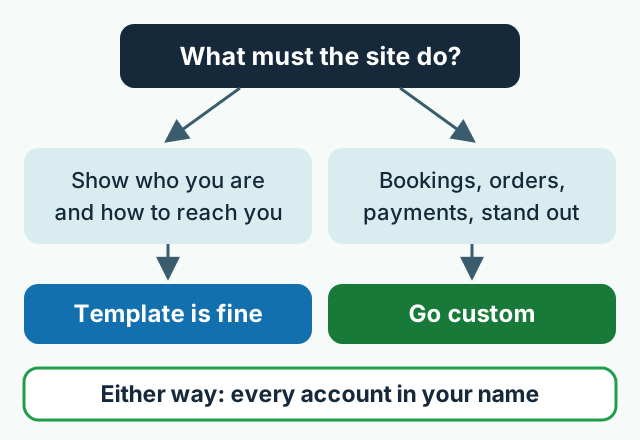
Before you choose, run through these:
- Write down what the website must do — show information only, or take bookings, orders or payments?
- Open a sample on your phone using mobile data. If it feels slow there, it will feel slow to your customers.
- Ask whose name the domain, hosting and accounts will be in. Get the answer in writing.
- Ask who changes things after launch, and what that costs.
- Compare what you get, not just the headline price or the delivery time.
If a template fits, use one with a clear conscience. If your website needs to work harder than that, a custom build is the investment that won't need redoing next year.
Frequently asked questions
Can a template website rank on Google?
Yes. Google ranks pages on whether they answer the search well and load properly, not on whether the design was bought or built. A slow, bloated template can hurt you, but a clean, light one can rank fine.
Can I move from a template to a custom website later?
Yes, and it is a common path. Keep your domain in your own name from day one, and save your text and photos, so moving later is a rebuild of the design and not a fresh start.
Does 77-Technologies build template websites?
No. We build custom designs and don't buy themes. If a template genuinely suits your business better, we will tell you so honestly on the call.
Is a custom website harder for me to update?
It doesn't have to be. Where you need to change products, prices or posts yourself, we build a simple admin panel and include a recorded training session at handover.