
You have heard the stories, or lived one. A developer took the full amount upfront, sent two screenshots, and then stopped answering WhatsApp. Or the opposite: you were asked to pay everything at the end, and the "end" never quite arrived.
Both problems have the same fix. You split the money into stages, and each stage is paid only after you see real, working progress.
How do milestone payments work on a software project?
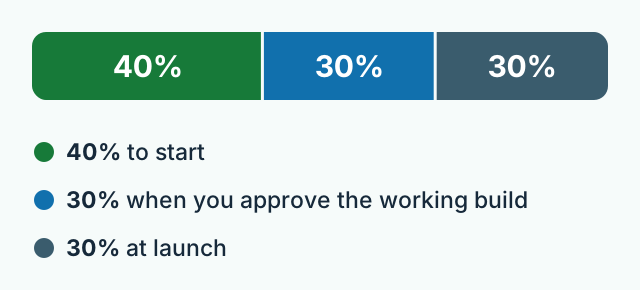
Milestone payments mean you never pay for work you haven't seen. At 77-Technologies the standard split is 40% to start, 30% when you approve the working build, and 30% at launch. The advance books the team and covers scoping and design. Every payment after that follows software you have tested yourself, not a promise.
This works the same way for a business website, a web app or a mobile app. The size of the project changes; the rule does not.
Why not pay everything at the end?
It sounds safest for you, but it pushes all the risk onto the developer. A serious team cannot block weeks of work with nothing committed, so "pay at the end" offers usually come from people who are not planning to stay long, or who will cut corners to finish fast.
Paying everything upfront has the opposite problem. Once the money is gone, you have no leverage left. If the work is late or wrong, all you can do is ask nicely.
Milestones sit in the middle. Nothing is fully prepaid and nothing is fully postpaid. The developer has a reason to keep going, and you have a reason to trust them.
What does the 40% advance actually pay for?
The first 40% is not a deposit sitting in an account. It pays for real work that starts in the first days:
- Scoping — turning your idea into a written list of pages, features and what is not included.
- Design — one tailored design concept, with 2 revision rounds, that you approve before any building starts.
- Booking the team — the people who will work on your project set time aside for it.
Because that work starts right away, the advance has clear rules, covered below.
What does "approved" mean at each milestone?
This is the word that matters most, so it should never be vague.
Approved means you have opened the working version yourself, checked it against the written proposal, and told us in writing that it is accepted. Not a slideshow, not a screenshot, not "trust us, it's nearly done". You get a review link you can open on your own phone.
Before you approve, check three things:
- Does it match the proposal? Every feature in the "Included" list for this stage should be there and working.
- Does it work on your phone? Most of your customers will use it there, so test it there.
- Are your notes fixed? Your revision rounds are for changes. Use them before you approve, not after.
Once you approve, that milestone is final. That is fair to both sides: you had the chance to test, and we can then build the next stage on solid ground. If you want something new later, it is quoted separately and you approve that price before we build it.
What does this look like for a real business?
Two illustrations — not clients, just typical situations:
- Say you run a pharmacy in Gulberg and want customers to send prescription orders from a website. You pay the advance, approve a design, then a few weeks later you open the review link, place a test order on your phone and check that it reaches you. Only then is the second 30% due. The last 30% is paid when the site is live on your own domain.
- Say you are a distributor in Gujranwala who needs a web app for shop orders and stock. It is a bigger project, so the proposal may list more stages, but each one still has a clear "this is what you will see working" before you pay for it.
In both cases, you can always answer the question "what have I paid for so far?" by pointing at something that works.
When do you get a refund?
Refunds follow our public Refund Policy, so here is the plain version:
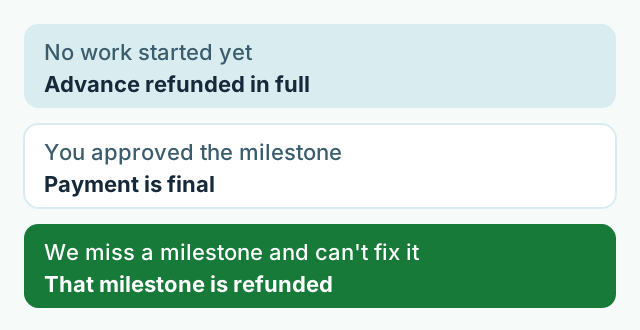
- Before work starts: if no scoping or design has been done, the advance is refunded in full.
- After work starts: the advance covers work already done, so it is not refunded.
- Approved milestones: these are final, because you tested and accepted them.
- If we fail to deliver: if we don't deliver a milestone as written in the proposal and can't fix it within a reasonable time, you get that milestone's payment back.
- If you cancel midway: you pay for the work completed to date; anything not yet started is not charged.
Third-party costs paid on your behalf, such as a domain or hosting, follow those companies' own rules and are not refundable once bought.
What should be in writing before you pay?
Whoever you hire — us or anyone else — ask for these before the first payment:
- A written, fixed quote with "Included" and "Not included" lists.
- The payment split, and exactly what you will see working at each stage.
- What "approved" means, and how many revision rounds you get.
- The refund and cancellation rules, in a document you can keep.
- A company name and address on the agreement, not just a phone number.
If you are comparing quotes, our post on what a website costs in Pakistan explains what usually sits inside the price. And if you would like to see how a project runs from first call to launch, have a look at how we work.
Frequently asked questions
Can I pay the whole amount at the end instead?
No. Nothing is fully prepaid and nothing is fully postpaid. Each payment follows something you have seen working, which protects both sides.
Is there a discount if I pay everything upfront?
Yes. We offer a 5% discount for 100% advance payment. Most clients still prefer milestones, and that is completely fine.
What happens if I cancel halfway through?
You pay for work completed to date and the advance is retained. Anything not yet started is not charged. This is written in the agreement you sign before we begin.
How do I pay each milestone?
By bank transfer from any bank, JazzCash or Easypaisa. International clients can pay by wire or Wise. You get an official invoice with every payment.