
A friend tells you about a tool that writes a hundred web pages overnight: one for every service, in every city. It sounds like free traffic. Then you hear that Google has just run another spam update, and you start to wonder whether the pages on your own site could get you into trouble.
Here is the short version, straight from Google's own pages.
Does Google's spam update punish AI content?
No, not for being AI-written. Google's spam updates target pages mass-produced to rank with little value for readers, however they were made. Its spam policy calls this "scaled content abuse", and it names using generative AI to churn out many pages as one example. A small business site with a handful of checked, specific pages written for real customers is not what these updates are after.
So the question is not "did a human or a machine type this?" It is "would a customer be glad they found this page?"
What did Google actually change recently?
Google lists its ranking updates on the Google Search Status Dashboard. According to that page, the most recent one is the September 2026 spam update, which started on 24 September 2026 and took about two weeks to roll out. It followed spam updates in March, June and August 2026 on the same dashboard.
Google does not publish a list of which sites were affected, and we won't guess. What the dashboard does tell you is that these updates now come several times a year. Any shortcut that relies on Google not noticing is a shortcut with a short life.
What does Google mean by "scaled content abuse"?
Google's spam policies page (last updated 28 August 2026) describes it as making many pages mainly to manipulate search rankings rather than to help people. It says this applies however the content was produced. The examples it gives include:
- using generative AI or similar tools to produce many pages that add nothing for the reader;
- taking other people's content and reworking it in bulk, for example by swapping synonyms or translating it;
- stitching text together from different pages without adding anything new;
- pages stuffed with search keywords that make little sense to a person.
Separately, Google's guidance on using generative AI content (last updated 1 October 2026) says AI can help with research and with structuring original content. It also stresses that you should fact-check everything a tool writes before publishing, including titles, descriptions and image alt text.
Why do mass-produced AI pages hurt a small business?
Even before Google steps in, bulk pages tend to work against you:
- They say nothing true about you. A tool doesn't know your prices, delivery areas or opening hours, so it fills the gaps with vague or wrong text.
- They look the same as everyone else's. If ten shops publish the same machine-written page, there is no reason for Google, or a customer, to pick yours.
- They lose the customer's trust. A buyer who lands on a page that promises "fast delivery across Pakistan" and then finds you only deliver in Lahore will not come back.
- They are hard to clean up. Two hundred thin pages take far longer to fix than six good ones took to write.
What does a helpful service page look like?
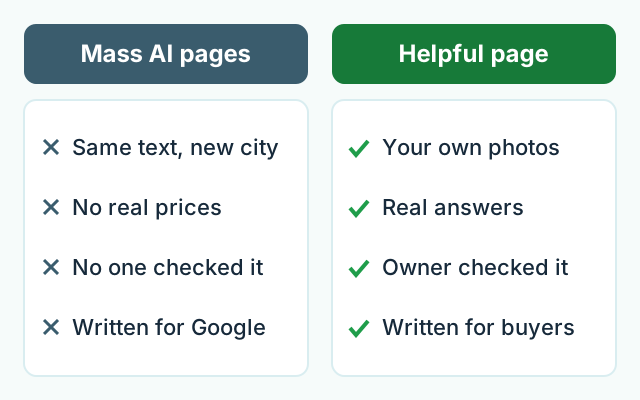
Say you run an AC repair service in Lahore. The tempting move is to publish "AC repair in Gulberg", "AC repair in DHA", "AC repair in Johar Town" and so on, each the same text with a new area name. That is exactly the pattern Google describes.
The better move is one strong service page that answers what a customer actually asks:
- Which areas you cover, and how soon a technician can usually reach them.
- What you fix, such as gas refills, cleaning, or a unit that won't cool, in your customers' own words.
- How pricing works: a visit charge, a written estimate before work starts, or "we quote after inspection".
- Your own photos of your van, tools and team at work, not stock images.
- How to book: a WhatsApp button and a phone number.
If one area really is different (a second branch, a different team, different timings), it can earn its own page. If the only difference is the name, it can't.
Can you still use AI to write your website?
Yes, if you use it as a helper rather than as the author. A sensible way to work:
- Write the facts yourself first: services, areas, timings, how you charge, what makes you different.
- Let the tool help with structure and wording, for example turning your notes into clear headings or simpler English.
- Check every sentence. Remove anything that isn't true for your business, especially promises and numbers.
- Add what only you have: real photos, real answers to questions customers ask you on WhatsApp, and your address.
- Publish fewer, better pages. Six pages you stand behind beat sixty you have never read.
Say you sell handmade bedsheets from home in Faisalabad. AI can help you write a clean "how to order" section. It cannot know your fabric, your delivery days or your return rules. Those are what make the page worth ranking.
What should you do this week?
- Open your site on your phone and read every page as a customer. Is anything vague, repeated or untrue?
- Merge or remove near-identical pages, such as copies that only change a city name.
- Add real details: areas, timings, how you price, your own photos.
- Check any AI-written text for wrong facts before it stays live.
- Run your site through our free website check to spot basic problems.
Nobody, including us, can promise how Google will rank a page. But a site made of honest, useful, checked pages is the one least likely to be hurt by the next update. If you want a site built that way from the start, see our fixed-price packages.
Frequently asked questions
Will Google penalise my site just for using ChatGPT to help write it?
Not for the tool alone. Google's policy is about pages made in bulk to manipulate rankings with little value for readers, however they were produced. A page you checked, corrected and filled with your own details is a different thing.
Should I delete old AI-written pages on my site?
Look at each one first. If a page is thin, repeated or wrong, improve it or remove it. If it genuinely answers a customer's question and the facts are right, keep it and add your own details.
Can anyone guarantee my site will recover after a spam update?
No. Google makes its own ranking decisions, so nobody can promise a recovery or a ranking. What you can control is making each page accurate, useful and clearly yours.
Is it safe to make one page for every city I serve?
Only if each page says something true and different, such as real delivery times, a real branch address or local work you actually do. Copies with just the city name swapped are the pattern Google describes as spam.