
Your Facebook page has a few thousand followers, people message you every day, and orders come in on WhatsApp. Then a relative asks, "Where's your website?" and you wonder whether you are missing something — or whether a website is just another expense someone wants to sell you.
Here is an honest answer from people who build websites for a living, including the part where we tell you that you might not need one yet.
Facebook page vs website: which does your business need?
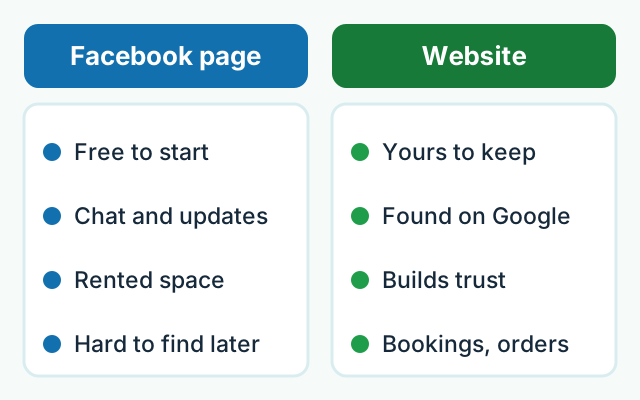
For many small businesses, a well-kept Facebook page is enough to start. If your customers already know you, find you through friends, and order by message, a page plus WhatsApp does the job. A website starts paying off when strangers need to trust you before they call, when people search Google for what you sell, or when you want bookings and orders without endless back-and-forth chats. Most growing businesses end up with both: the page for conversation, the website as the permanent home.
When is a Facebook page really enough?
Be honest with yourself about how customers reach you today. A page alone is usually fine when:
- Most customers come through people who already know you — neighbours, regulars, family referrals.
- You sell to a small, local circle and everyone already has your number.
- Your offer is simple: a few products or one service, with prices you can explain in a chat.
- You are still testing the idea. Before you know what sells, spending on a website is premature.
Say you run a home kitchen in Gulberg that makes lunch boxes for nearby offices. Your customers find you through colleagues, see the daily menu on your page, and order on WhatsApp. A website would add little right now. Your time is better spent on good photos, quick replies and a free Google Business Profile so people nearby can find you on Maps.
Where does a Facebook page fall short?
A page is rented space. It works well until it doesn't, and these are the places it usually stops working:
- Google rarely shows your page for what you sell. When someone searches "bridal makeup in Lahore" or "AC repair near me", they mostly see websites and map listings. A page is built for followers, not for search.
- You don't own it. Meta decides who sees your posts, what you may advertise, and whether your page stays up. A hacked or restricted account can cut you off from customers overnight, and there is no one local to call.
- Information gets buried. Your prices, timings and service details sit in old posts. Customers ask the same questions again and again because they can't find the answer.
- New customers hesitate. A company or a buyer who has never heard of you often checks for a proper website before trusting you with a big order or an advance payment.
- Ordering by chat doesn't scale. At ten orders a day, chat is fine. At many more, missed messages and mixed-up addresses start costing you sales.
When does a website start paying off?
A website earns its cost when it does a job your page can't. Look for these signs:
- People search for your service, not your name. If customers are typing what you do plus your city, you want something Google can show them. Our guide to SEO basics for small businesses explains how that works.
- You sell to businesses or bigger buyers who judge you before they reply.
- You answer the same questions all day about prices, timings, sizes or delivery.
- You want bookings or orders that arrive complete, with name, address and choice already filled in.
- You plan to run ads and want them to land somewhere you control.
Say you run a fabric wholesale business in Faisalabad and retailers from other cities find you on Facebook. They want to see the full catalogue, minimum order, and how delivery works before calling. A simple website with a catalogue and an order form answers all of that once, and your page keeps sending people to it.
Do you have to choose one or the other?
No, and you shouldn't. The two do different jobs and work best together:
- The page is for daily posts, offers, conversation and showing that you are active.
- The website is for the facts that don't change every day, for Google, and for taking bookings or orders properly.
- They point to each other. Your page's link goes to your website; your website has a WhatsApp button and links back to your page.
If you are also wondering whether you need a mobile app on top, we answer that separately in app or website: which does your business need first? For most small businesses, the honest answer is a website first.
What does a business website cost compared with a free page?
A Facebook page is free to create; your real cost is time and, if you boost posts, ad spend. A custom business website with us starts from PKR 50,000, and most simple business sites land at 50–80k. After launch, domain and hosting typically cost PKR 10,000–15,000 a year, billed at cost and kept in your own name.
That is real money for a small business, so only spend it when the signs above apply. You can see what is included in our fixed-price packages.
A quick checklist: page only, or page plus website?
Tick the ones that are true for you today:
- Customers search Google for what I sell, not just my name.
- New or bigger customers ask if I have a website.
- I answer the same questions about prices and timings every day.
- I want bookings or orders to arrive complete, not by chat.
- I would lose most of my customers if my Facebook page disappeared tomorrow.
None or one ticked: keep improving your page and Google Business Profile for now. Two or more: a simple website is likely to pay for itself, and you can keep your page running alongside it.
Frequently asked questions
Can I run a business only on Facebook and WhatsApp?
Yes, many small businesses do, especially when most customers already know them or come through referrals. The risk is that you depend on one platform's rules and reach, and you own none of it.
Will a website replace my Facebook page?
No. Most businesses keep both. The page is where people chat and see daily updates; the website is the permanent, searchable home that the page links to.
Do I need to post on the website as often as on Facebook?
No. A business website mostly holds information that changes slowly: services, prices or packages, timings, location and contact. You update it when those change, not every day.
What should I build first if my budget is small?
Start with a well-kept Facebook page and a free Google Business Profile. Add a website when customers start asking for things a page can't do well, such as booking, ordering or comparing your services in detail.