
"Should we make an app?" is one of the first questions we hear from business owners — usually because a competitor has one, or a relative said apps are the future. It is a fair question. But for most businesses, an app is the wrong first step, and a costly one.
This post gives you a plain way to decide, based on how your customers actually behave.
Do I need an app or a website?
For most small and medium businesses, start with a mobile-friendly website. Customers find you on Google, open it in one tap from WhatsApp or Instagram, and don't have to install anything. An app makes sense when the same customers come back often — ordering every week, booking regularly, tracking something daily — or when you need phone features like push notifications, the camera, location or offline use. If neither is true for you yet, a website will do more for less.
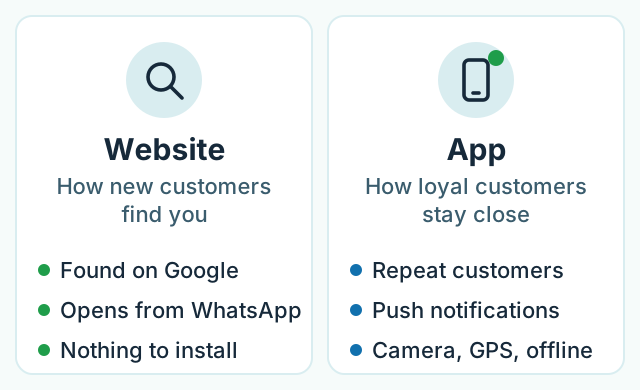
The reason is simple: people search for a business, but they only install an app for a business they already use and trust. A website is how new customers find you. An app is how loyal customers stay close.
What can a website do that people don't expect?
Many owners picture a website as a digital brochure. A modern website can do far more, right in the phone's browser:
- Take bookings for a clinic, salon or consultant, with confirmations on WhatsApp.
- Take orders, including cash on delivery, and online payments through JazzCash, Easypaisa or a card gateway.
- Give customers a login to see their orders, invoices or appointments.
- Sit on the home screen. A visitor can add it to their phone's home screen, and it opens full-screen like an app.
- Show up on Google when someone searches for what you sell — something an app alone cannot do.
When a website has logins, dashboards and staff roles, we call it a web application. It gives you most of what an app does, without asking anyone to download anything.
When does a mobile app actually make sense?
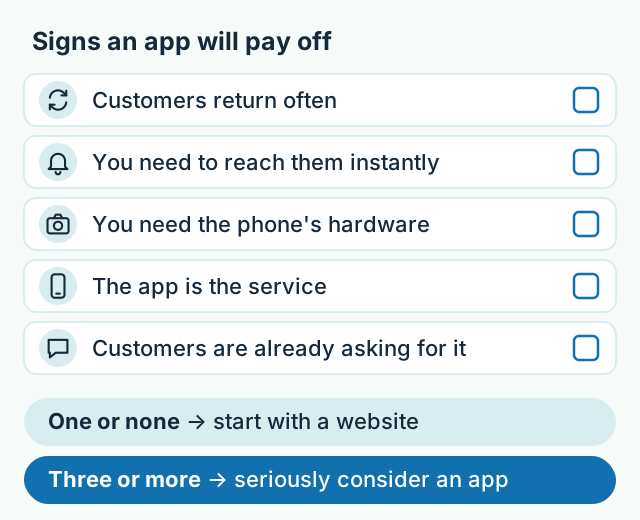
An app starts to earn its cost when several of these are true:
- Customers return often. Weekly grocery orders, daily rate checks, regular bookings. If people only visit you once or twice a year, they won't keep your app.
- You need to reach them instantly. Push notifications for order updates, price alerts or reminders are an app's strongest feature.
- You need the phone's hardware. Scanning, photos, GPS tracking for riders, or working without internet in the field.
- The app is the service. A booking platform, a delivery service or a marketplace where the app is what customers pay for.
- You already have customers asking for it. Real demand beats a guess.
If you ticked one or none, start with a website. If you ticked three or more, an app is worth a serious conversation.
What does each option involve?
| Business website | Web application | Mobile app | |
|---|---|---|---|
| Found on Google | Yes | Yes (public pages) | No, only in app stores |
| Needs installing | No | No | Yes |
| Push notifications | Limited | Limited | Yes |
| Typical build time | 2–3 weeks | 4–8 weeks | 6–10 weeks |
| Starting price | From PKR 50,000 | See packages | See packages |
An app also carries costs a website doesn't. Apple and Google charge their own developer account fees — check the current amounts on the Apple Developer Program and Google Play Console pages. Each new Android and iOS version can need updates, and every release goes through store review. None of that is a reason to avoid an app — just a reason to build one when it will pay for itself.
What does this look like in practice?
A real example from our work: PoultryBaba, a poultry market-intelligence platform in Pakistan. We built it end-to-end — a web platform with live murghi-mandi rates, a B2B directory and an Android app. It suits both, because farmers and traders check rates again and again, which is exactly the "customers return often" signal, while the web platform is what people find on Google.
And three illustrations of typical situations — not clients:
- Say you run a bakery in Lahore with two branches. Customers want your menu, your location and a way to order a cake. A website with a WhatsApp order button covers it. An app would sit unused on most phones.
- Say you run a school. Parents want fee vouchers, results and notices. A web portal with parent logins is the right start. If parents later need instant alerts, an app can be added on top of the same system.
- Say you run a delivery business with riders across the city. Riders need live location, order updates and proof-of-delivery photos. That is a genuine app use case — for the riders, even if customers order through a website.

Can you start with a website and add an app later?
Yes, and it is usually the best order. Build the website first, learn what customers actually use, then build the app around the features they return for. If the website is built on a proper backend, the app can reuse the same products, orders and customer accounts, so you are not paying for the same thing twice.
A quick way to decide
Answer these five questions honestly:
- Do most new customers find you through Google or social media? → You need a website.
- Do the same customers come back every week or more? → An app may pay off.
- Do you need notifications, GPS, camera or offline use? → That points to an app.
- Is your budget for one project this year? → Start with the website.
- Are customers already asking for an app? → Take it seriously.
Still unsure? Tell us about your business and what your customers do, and we will tell you honestly which one fits — even if the answer is "not yet". Send us a message and a real person on our team will reply.
Frequently asked questions
Can a website work like an app on a phone?
Yes. A well-built website can be added to the phone's home screen, open full-screen, and take bookings, orders and payments. For many businesses that covers everything an app would do.
Can I start with a website and add an app later?
Yes, and it is usually the smarter order. If the website is built on a proper backend, a mobile app can later reuse the same data, products and customer accounts instead of starting from zero.
Do I need separate apps for Android and iPhone?
No. We build one app from a single codebase that runs on both Android and iPhone, and publish it to the Play Store and the App Store in accounts that are in your name.
How long does a mobile app take compared to a website?
A business website takes 2–3 weeks, a web application 4–8 weeks, and a mobile app 6–10 weeks. Each proposal carries a committed delivery date.