

The phone rings while you are serving a customer. It rings again during Friday prayers, and again after you close. Each missed call was someone who wanted a booking, a price or your location, and many of them simply call the next business on the list.
Until now the fixes were a second staff member or a "press one for timings" menu that everybody hates. This autumn, OpenAI and Google both released their newest live voice models for real business use. Can a small business now let AI pick up the phone?
Can an AI voice agent answer phone calls for your business?
Yes, for routine calls. An AI voice agent can now answer phone calls for a business, hold a natural spoken conversation, take a booking or answer a common question from your own information, and transfer the caller to a person. It is not ready to be left alone on the line. Urdu quality has to be tested with your real callers, and complaints, payments and anything urgent still need a human.
In short: let it catch the calls you would have missed, not replace the person who knows your customers.
What changed with voice AI this year?
Older phone bots worked in three slow steps: turn the caller's speech into text, think, then turn the reply back into speech. The pause made people hang up. The new models listen and speak as one system, so a caller can interrupt, pause or change their mind, much like a normal call.
Two releases matter, and both are recent:
- OpenAI. OpenAI's API changelog lists GPT-Live-1 as generally available on 10 September 2026, for voice conversations that carry on while a second model does the thinking and uses the tools. Its developer guide names telephony as one of the ways to connect it. The same changelog shows that OpenAI's older Realtime API became generally available on 28 August 2025, more than a year ago, so phone agents are not brand new. What is new is how natural the conversation feels.
- Google. Google announced Gemini 3.8 Live on 15 September 2026, saying it detects and switches between supported languages in the middle of a conversation and runs tools in the background while it keeps talking. In a post dated 25 September 2026, Google Cloud said the model is generally available in Gemini Enterprise, on US and EU endpoints.
"Generally available" means the company now supports the product for real business use, not only for experiments. It does not mean it works well for every language or on every phone line.
What can a voice agent do on a business line today?
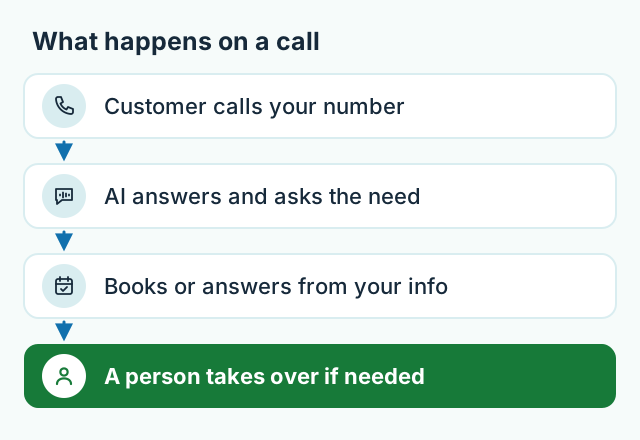
Say you run a dental clinic in Johar Town. Between patients, the phone keeps ringing with the same few questions. A voice agent set up with your own information can:
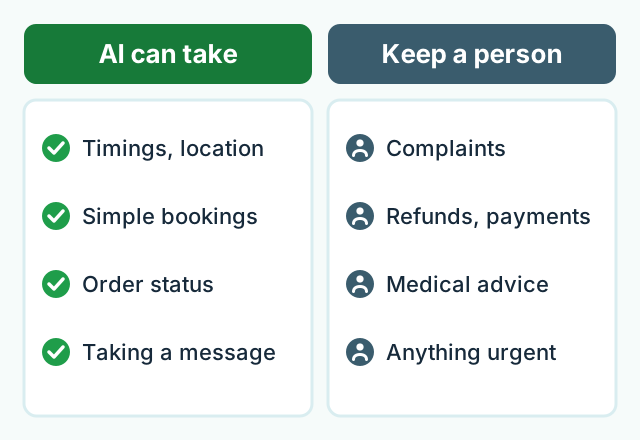
- Answer the routine questions. Timings, location, which doctor sits on which day, whether you take walk-ins. For a shop or courier, where an order has reached.
- Take a booking. Both companies describe the agent using "tools" during a call. In plain words, it can check your appointment diary and write the booking into it while it is still talking.
- Take a message after hours, with the caller's name, number and need, and pass it to your team for the morning.
- Transfer the call. OpenAI's guide for phone calls describes accepting a call, ending it, and transferring it to another number. That is how a caller reaches your staff.
It cannot do any of this from general internet knowledge. It needs your real timings, prices and rules, written down, the same as a new receptionist on the first day.
How good is the Urdu?
This is the honest weak point. Urdu is on the list of supported languages in Google's Live API guide, and the guide says the models can switch languages naturally during a conversation. That is encouraging. But the pages we read give no Urdu-specific test results, and a language on a list is a starting point, not a promise.
Real callers in Pakistan don't speak textbook Urdu. They mix Urdu, Punjabi and English in one sentence, use local area names, read out phone numbers quickly, and call from a motorbike in traffic. OpenAI's changelog has an entry dated 6 July 2026 for an updated voice model, and the improvements it lists are recognising letters and numbers, handling silence and noise, and handling interruptions. Those are exactly the places where phone agents stumble.
So test before you trust:
- Ask five people with different accents to call the test line.
- Have them mix languages, interrupt, spell a name and read out a phone number.
- Listen to the test calls yourself and note how often the booking came out exactly right.
If full conversations are shaky, a simpler agent that only takes messages may still be worth having.
When should a person take over?
A voice agent should hand over early, not argue. Set these rules before you launch:
- The caller asks for a person, at any point.
- The agent fails to understand twice in a row.
- The call is a complaint, a refund, a payment problem, or anything medical or legal.
- The caller sounds upset, or the matter is urgent.
Decide where the call goes, too. In working hours that is your reception line. After hours it is a message with an honest call-back time.
Tell callers at the start that they are speaking to an automated assistant. People forgive a machine that is honest. They do not forgive one that pretends.
When is a voice agent not worth the money?
Be honest with yourself here.
- You get a few calls a day. Calling back within the hour costs nothing.
- Your customers are on WhatsApp. Many small businesses in Pakistan get more messages than calls. A WhatsApp bot is simpler to run, and we explained the rules in our post on Meta's rules for business bots on WhatsApp.
- Your information is not written down. If prices and timings live in your head, fix that first. It helps your staff too.
- Every call is different. A lawyer or a custom tailor sells judgement, not standard answers.
A voice agent earns its place when calls are frequent, repetitive and often missed. Say you run a home-appliance repair service in Karachi, and calls go unanswered while your technicians are out on jobs. An agent that takes the address, the appliance and a preferred time is a real gain.
Two practical notes. Both companies bill by usage and their prices change, so we don't repeat them here. And the agent has to be connected to your number through a telephone provider, so ask your provider what is possible before you plan anything.
A short checklist before you try one
- Write down the ten questions callers ask most, with exact answers.
- Decide what the agent may do: answer, book, or only take a message.
- Set the handover rules and the number that calls transfer to.
- Test with real Urdu, Punjabi and English callers before going live.
- Start with after-hours or overflow calls, not your main line all day.
- Review the calls every week at the beginning.
We build AI chatbots and automation for websites and WhatsApp, and a phone agent follows the same rules: your own information, clear limits and a person behind it. If you want to know whether one fits your business, see our services or send us a short message with how many calls you get and what callers ask. We quote after a short call. If a WhatsApp bot or a call-back habit is enough, we will say so.
Frequently asked questions
Can an AI voice agent speak Urdu on a phone call?
The newest models list Urdu among their supported languages, but a listing is not a quality guarantee. Test it with real callers, accents and mixed Urdu-English sentences before you put it on your main number.
Will callers know they are talking to AI?
They should, because you tell them. Start every call with a short line saying this is an automated assistant and that the caller can ask for a person at any time.
Do I need a new phone number for a voice agent?
Not always. The agent is connected through a telephone provider, and whether your current number can be used depends on that provider. Ask them before you plan anything.
What does an AI voice agent cost to run?
The AI companies bill by usage and their prices change, so check their own pricing pages. Setting one up for your business is a custom project that we quote after a short call.
Is a voice agent better than a WhatsApp chatbot?
For many small businesses in Pakistan, WhatsApp comes first because that is where customers already message. A phone agent makes sense when customers still prefer to call and those calls go unanswered.