

A customer asks a simple thing: "Can we just connect ChatGPT to our WhatsApp number and let it answer everyone?" It sounds like the obvious shortcut. Your customers are already on WhatsApp, and AI can write a reply in seconds.
The answer is more careful than yes or no, because Meta has written a specific rule about AI on the WhatsApp Business Platform. Here is what it says, when it started, and what it means for a shop, clinic or distributor in Pakistan.
Can you put ChatGPT on WhatsApp for your business?
You cannot run a general-purpose AI assistant like ChatGPT on the WhatsApp Business Platform, but you can run a bot that uses AI to serve your own customers. Meta's terms bar AI providers from using the platform when AI itself is the product. A bot that answers questions about your prices, timings, orders and bookings is a customer-service tool, and that is exactly what the platform is for.
In short: the bot must be about your business, not about everything.
What exactly did Meta change?
The rule sits in section 4.7 of the Meta Terms for WhatsApp Business Platform, in the version effective 23 September 2026. It defines "AI Providers" as makers of AI technology such as large language models, generative AI platforms and general-purpose AI assistants. It then says they may not use the platform to offer that technology when it is the primary function, rather than something "incidental or ancillary".
This is not brand new. TechCrunch reported on 18 October 2025 that WhatsApp had changed its business terms to bar general-purpose chatbots, with the change taking effect on 15 January 2026. The same report named ChatGPT, Perplexity, Luzia and Poke among the assistants affected. Meta told TechCrunch that businesses using AI to serve their customers were not the target, and gave the example of a travel company running a customer-service bot.
Meta's stated reason, in the same TechCrunch report, was that the Business API was built for businesses talking to customers, not as a way to distribute standalone AI products.
What kind of business bot is still allowed?
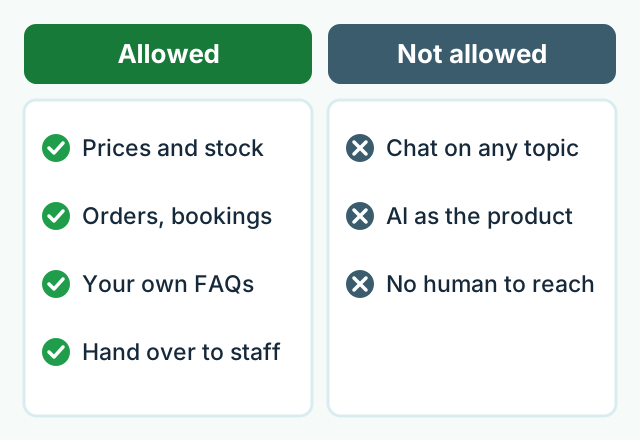
Almost everything a normal Pakistani business wants a bot for is on the allowed side. For example:
- Answering common questions: prices, sizes, stock, delivery areas, timings, location.
- Taking an order or a booking and confirming it.
- Sending an order status or a delivery update to a customer who asked for it.
- Collecting a customer's name and need, then passing it to your sales team.
- Replying in Urdu, Roman Urdu or English, using your own information.
AI can power all of these. The difference is scope. A clinic bot that understands a patient's messy Roman Urdu message and books the right doctor is using AI to serve customers. A bot that will happily write homework, tell jokes or give opinions on cricket is drifting into general-assistant territory.
What rules apply to any WhatsApp bot?
Even a perfectly allowed bot must follow WhatsApp's Business Messaging Policy, last updated on 23 September 2026. Two points matter most:
- A way to reach a person. If you automate replies, the policy asks for prompt, clear and direct ways to escalate: a transfer to your team in the chat, a phone number, email, a web page or your shop.
- Permission before you message. You may only message people who gave you their number and agreed to hear from you. The business, not the software company, is responsible for that consent.
So "let the AI handle everyone and nobody reads the chats" is not a plan. It is also bad service: the customer with a complaint or a special order wants a human.

Is the rule the same everywhere?
Not quite. The terms themselves say the restriction does not apply in certain countries listed by Meta, and regulators in Europe have pushed back. The European Commission opened an antitrust investigation on 4 December 2025 into whether the policy shuts rival AI providers out of WhatsApp in the European Economic Area.
For a business in Pakistan this is background, not a loophole. The fight is about AI companies distributing their assistants, not about a bakery in Karachi answering order questions. Your practical rules are the same either way: keep the bot about your business, and keep a person reachable.
What should you do now?
Say you run a pharmacy delivery service in Lahore and get the same forty questions every evening. Here is a sensible order of steps:
- Try the simple tools first. The free WhatsApp Business app has quick replies, greeting and away messages, and Meta now offers its own AI agent inside it. We covered that agent in our Urdu post on the WhatsApp Business AI agent.
- Write down the questions you actually get. A good bot is built on your real prices, timings and policies, not on general internet knowledge.
- Decide what the bot must never answer. Medical advice, refunds, complaints and custom orders should go to a person.
- Keep the bot on-topic. When a customer asks something unrelated, the bot should politely steer back or hand over, not chat.
- Only go custom when you need it. A custom bot makes sense when it must check your stock, bookings or order system, or work on your website too.
And when not to spend money: if you get a handful of messages a day and reply within the hour, you don't need a bot yet. Fast human replies still win customers.
Where do we fit in?
We build customer-service chatbots for websites and WhatsApp that answer in Urdu or English, collect leads and book appointments, using only your own business information and with a clear handover to your team. Each one is quoted after a short call. If the free tools are enough for you, we will say so. See our services, or send us a short message about the questions your customers ask most.
Summary
- Meta's WhatsApp Business Platform terms bar general-purpose AI assistants when AI is the main product.
- Bots that use AI to serve your own customers, like orders, bookings and FAQs, are still allowed.
- Any bot must offer a clear way to reach a person, and you need customers' permission to message them.
- Start with the free WhatsApp Business tools; build a custom bot only when it must connect to your systems.
Frequently asked questions
Is it now illegal to use AI on my WhatsApp Business number?
No. It is a platform rule, not a law, and it targets companies whose main product is a general AI assistant. A business using AI to answer its own customers about its own products and services is not what the rule is aimed at.
Can my bot answer a question that is slightly off-topic?
The line Meta draws is whether AI is the main thing on offer or only supports your business. A clinic bot that answers a patient's question about parking is fine; a bot that writes essays or chats about anything is a general assistant.
Does the WhatsApp Business app on my phone follow the same rules?
The AI Providers clause sits in the terms for the WhatsApp Business Platform, the API used by larger businesses and software providers. The free app on your phone has its own terms, and Meta offers its own AI agent inside it.
Do I need a human behind the bot?
Yes, in practice. WhatsApp's Business Messaging Policy asks businesses using automation to give customers a clear way to reach a person, such as a transfer to your team or a phone number.